
What Is a Candlestick Chart?
A candlestick chart is a tool used in financial analysis to show the highest, lowest, opening, and closing prices of a stock or other security for a specific time period. Each “candlestick” on the chart shows one time period, like a day or an hour, and visually represents how the price moved during that time.
candlesticks are formed using the open, high, low and close of the chosen time frame.

1. Components of a Candlestick
Body: The thick part of the candlestick, which represents the range between the opening and closing prices.
- If the close is above the open, we can say that the candlestick is bullish which means that the market is rising in this period of time. Bullish candlesticks are always displayed as white candlestick
- If the close is below the open, we can say that the candlestick is bearish which indicates that the market is falling in this session. Bearish candles are always displayed as black candlesticks .
You can find different colors used to differentiate between bullish and bearish candlesticks.
- The filled part of the candlestick is called the real body.
- The thin lines poking above and below the body are called shadows.
- The top of the upper shadow is the high
- The bottom of the lower shadow is the low.
Wicks(Shadows): The thin lines above and below the body, indicating the highest and lowest prices during the period.
- Upper wick: The high price for the period.
- Lower wick: The low price for the period.

Long bodies refer to strong buying or selling pressure, if there is a candlestick in which the close is above the open with a long body, this indicates that buyers are stronger and they are taking control of the
market during this period of time.
if there is a bearish candlestick in which the open is above the close with a long body, this means that the selling pressure controls the market during this chosen time frame.
Long Body: Indicates strong buying or selling pressure. A long green body shows strong buying pressure, while a long red body shows strong selling pressure.
Short Body: Indicates less price movement and potential indecision in the market.
Long Shadows

The upper and lower shadows give us important information about the trading session.
- Upper shadows signify the session high
- Lower shadows signify the session low
Long Wicks: Suggest that prices moved significantly during the period but were pushed back to the opening or closing price level.
No Wicks: Suggests that the opening or closing price was also the high or low price for the period.
2. Major category of candlesticks are
2.1 Single Candlestick Patterns
- Doji
- Dragonfly Doji
- Gravestone Doji
- Hammer
- Inverted Hammer
- Hanging Man
- Shooting Star
- Marubozu
- Spinning Top
2.2 Two-Candle Patterns
- Bullish Engulfing
- Bearish Engulfing
- Bullish Harami
- Bearish Harami
- Piercing Pattern
- Dark Cloud Cover
- Tweezer Bottom
- Tweezer Top
- Inside Bar
2.3 Three-Candle Patterns
- Morning Star
- Evening Star
- Three White Soldiers
- Three Black Crows
- Three Inside Up
- Three Inside Down
1.Doji Candlestick
When doji candlestick forms, it indicates that the market opens and closes at the same price. This means there is equality and indecision between buyers and sellers, with no one controlling the market.
This signal means that the market didn’t decide which direction will take. When this pattern occurs in an uptrend or a downtrend, it indicates that the market is likely to reverse.
1.1 Structure:
A Doji has a very small or almost zero real body, meaning the Open and Close prices are nearly the same. It can have upper and lower wicks of different lengths.

1.2. Formation:
A Doji forms when buyers and sellers fight during the trading session, but neither side is able to gain clear control. The price may move significantly during the session but eventually closes near its opening price.
1.3 Psychology:
The Doji represents indecision and uncertainty in the market.
- Buyers tried to push the price higher.
- Sellers tried to push the price lower.
- Neither side was able to dominate.
Therefore, the market ends close to where it started.
1.4 Signal:
A Doji generally indicates indecision, not an automatic buy or sell signal.
Its importance depends heavily on its location and the preceding trend.
- After a strong uptrend : possible bullish-to-bearish reversal
- After a strong downtrend : possible bearish-to-bullish reversal
- During sideways movement : usually less significant
1.5 Example
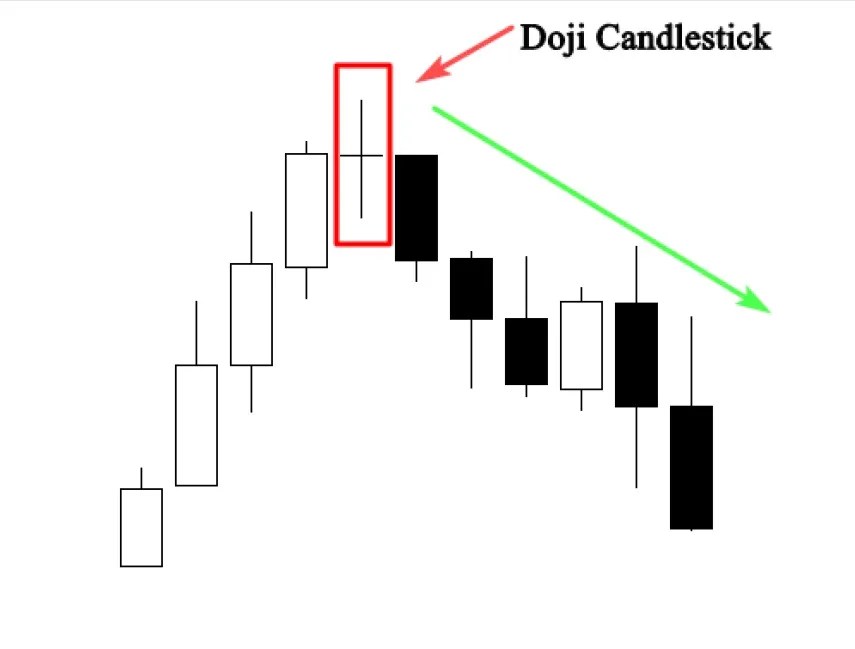
The chart above shows how the market changed direction after the formation of the doji candlestick.
The market was trending up, that means that buyers were in control of the market.
The formation of the doji candlestick indicates that buyers are unable to keep price higher, and sellers push prices back to the opening price
2.Dragonfly Doji Candlestick
The Dragonfly Doji is a bullish candlestick pattern which is formed when the open high and close are the same or about the same price. what characterizes the dragonfly Doji is the long lower tail that shows the resistance of buyers and their attempt to push the market up.

The long lower tail suggests that the forces of supply and demand are nearing a balance and that the direction of the trend may be nearing a major turning point.
2.1Structure:
A Dragonfly Doji has:
- Open and Close near the same price
- Very long lower shadow
- Little or no upper shadow
- The candle looks like a “T”
2.2 Formation:
The price initially moves strongly downward, but buyers enter the market and push the price back up. By the end of the session, the price closes near the opening price.
2.3 Psychology:
The long lower wick shows that sellers were initially in control, pushing the price significantly lower. However, buyers eventually absorbed the selling pressure and pushed the price back toward the opening level. This2.4 indicates that buyers are becoming stronger and sellers are losing control.
2.4 Signal:
A Dragonfly Doji can indicate a potential bullish reversal, particularly after a strong downtrend. However, it is not automatically a buy signal. Its reliability depends on where it appears and what happens afterward.
2.5 Example

The formation of the dragonfly Doji with the long lower tail shows us that there is a high buying pressure in the area .When it occurs in a downtrend, it is interpreted as a bullish reversal signal.
The chart can be divided into three stages:
Downtrend ↓ → Dragonfly Doji → Bullish reversal ↑
On the left side, the stock is clearly moving downward. Sellers are continuously pushing the price lower. Then, near the bottom, the red box highlights the Dragonfly Doji. After that candle, the price begins moving upward, which is shown by the green arrow.
3. Gravestone Doji Candlestick
The Gravestone Doji is the bearish version of the dragonfly Doji, it is formed when the open and close are the same or about the same price . The formation of the long upper tail is an indication that the market is testing a powerful supply or resistance area.

This pattern indicates that while buyers were able to push prices well above the open . Later in the day sellers back in the market pushing the price back down.
This is interpreted as a sign that bulls are losing their momentum and the market is ready for a reversal
3.1 Structure:
A Gravestone Doji has:
- Very small or almost zero real body
- Long upper shadow
- Little or no lower shadow
- Open and Close are near the low of the candle
- It generally looks like an inverted “T”
3.2 Formation:
The price initially moves strongly upward, but sellers enter at higher levels and push the price back down. By the end of the candle, the price closes near the opening/low price.
So the basic formation is:
Price rises strongly → Sellers enter → Price falls back → Close near Open
3.3 Psychology
The Gravestone Doji represents a battle between buyers and sellers.
Initially:
Buyers: Push the price significantly higher.
Sellers: Enter at higher prices and aggressively reject those higher levels.
3.4 Signal
A Gravestone Doji can indicate a potential bearish reversal, particularly when it appears after a strong uptrend.However, it should not be treated as an automatic SELL signal.
For example:
Strong Uptrend → Gravestone Doji → Bearish Confirmation
This is much stronger than simply seeing a Gravestone Doji.
3.5 Example

The formation of this candlestick pattern indicates that buyers are no longer in control of the market. For this pattern to be reliable, it must occur near a resistance level .
4. Hammer Candlestick
The Hammer Candlestick Pattern is one of the most powerful bullish reversal patterns in technical analysis. It appears after a downtrend and signals that sellers are losing control while buyers are starting to take over.
The Hammer candlestick forms when the open, high, and close are nearly the same, with a long lower shadow signaling a bullish rejection by buyers aiming to drive the market higher.
A hammer indicates that although sellers pushed prices significantly lower during the trading session, buyers managed to regain control and close the price near the opening level.
4.1 Structure:
A valid hammer candlestick has the following characteristics:
- Small real body near the top of the candle
- Long lower shadow (at least 2 times the body size)
- Little or no upper shadow
- Appears after a downtrend

The hammer is a reversal candlestick pattern when it occurs at the bottom of a downtrend .
- Open Price: ₹100
- Low Price: ₹90
- Close Price: ₹101
During the day, sellers pushed the stock down to ₹90. However, buyers entered aggressively and pushed the price back up to ₹101 before the market closed.
This shows strong buying interest at lower levels.
4.2 Characteristics of a Hammer Candlestick:
- Shape: The hammer has a small body with a long lower shadow (at least twice the length of the body). The upper shadow is either very small or nonexistent.
- Color: The color of the hammer’s body can be either green (bullish) or red (bearish). However, a green hammer is often considered more bullish because it indicates a stronger buying pressure.
- Position in Trend: The hammer must appear after a downtrend. This is essential because the pattern is only considered a reversal signal when it follows a decline.
4.3 Psychology
Bullish Reversal Signal: The long lower shadow indicates that sellers pushed the price down significantly during the trading session, but strong buying pressure ultimately drove the price back up near the opening level. This suggests that buyers are starting to gain control.
4.4 Example

As you can see the market was trending down, the formation of the hammer (pin bar) was a significant reversal pattern.
The long shadow represents the high buying pressure from this point. Sellers was trying to push the market lower, but in that level the buying power was more powerful than the selling pressure which results in a trend reversal.
5.Inverted Hammer
The Inverted Hammer candlestick pattern is a bullish reversal pattern that typically forms at the bottom of a downtrend, indicating a potential reversal in trend. It resembles the Hammer pattern but with the shadows reversed.

5.1 Structure:
Small real body
- The body is relatively small.
- It can be green (bullish) or red (bearish).
- The color is less important than the overall shape.
Long upper shadow
- The upper wick should be at least about 2× the size of the real body.
- It shows that buyers pushed the price significantly higher during the candle.
Very small or no lower shadow
- The candle should have little lower wick.
- Ideally, the low is close to the open/close area.
5.2 Characteristics:
- Shape: The Inverted Hammer has a small body at the lower end of the trading range with a long upper shadow (at least twice the length of the body). The lower shadow is either very small or nonexistent.
- Color: The body of the Inverted Hammer can be either green (bullish) or red (bearish), but the color is less significant than the overall shape. A green body is often considered slightly more bullish.
5.3 Psychology:
Bullish Reversal Signal: The long upper shadow indicates that buyers tried to push the price higher during the trading session, but they were met with selling pressure that brought the price back down near the opening level. Despite this, the presence of buying pressure suggests that bulls may start gaining control, potentially leading to a reversal.
Phase 1: Fear Dominates (Opening)
- The candle opens, and the overall sentiment is still negative
- Most traders expect price to keep falling
- Sellers are confident
Phase 2: Sudden Buying Pressure (During the Candle)
- Out of nowhere, buyers step in aggressively
- Price shoots up strongly (this creates the long upper wick)
Now something interesting happens:
- Short sellers start getting nervous
- Some traders think: “Is the trend reversing?”
Phase 3: Sellers Fight Back (Closing)
Price is pushed back down near the opening level
Sellers try to regain control
Shape resembles an inverted hammer
- Small body at the bottom.
- Long wick extending upward.
5.3 Example:

if you see the above chart shows that the market began the day by gapping down. “Prices increased until encountering resistance and supply at the daily high.
Support Levels: The Inverted Hammer occurs near significant support levels on the price chart. These levels act as barriers where buyers are more likely to emerge and defend against further downward movement.
Note:- Please avoid trading based solely on candlestick patterns. Instead, confirm the candlestick signals with support and resistance levels, as these patterns are more reliable when they occur near key levels
6. Hanging Man Candlestick
A Hanging Man is a single-candle bearish reversal warning pattern that usually appears after an uptrend.
It looks similar to a Hammer, but the location is different:
- Hammer → appears after a downtrend → potentially bullish
- Hanging Man → appears after an uptrend → potentially bearish

6.2. Structure
The Hanging Man has:
- Small real body at the top.
- Long lower shadow/wick, generally at least 2× the size of the body.
- Very small or no upper shadow.
- It can be green or red, although a red/bearish candle can provide a stronger warning.
6.3 Psychology
During the Hanging Man candle:
1. Sellers suddenly become aggressive
They push the price significantly lower, creating the long lower wick.
2. Buyers recover the price
Buyers step in and push the price back toward the opening/closing area.
3. But something has changed
Even though buyers recovered the price, the fact that sellers were able to push the price sharply lower shows that selling pressure is starting to appear.
6.4 Example
7. Shooting Star Candlestick
A Shooting Star is a single-candle bearish reversal warning pattern that typically appears after an uptrend.
It shows that buyers pushed the price significantly higher during the session, but sellers came in strongly and pushed the price back near the opening level.

7.2. Structure
A proper Shooting Star generally has:
- Small real body near the bottom of the candle.
- Long upper shadow, ideally at least 2× the size of the body.
- Little or no lower shadow.
- The candle can be red or green.
- A red/bearish body is generally considered stronger, but the shape and location are more important than the color.
7.3 Psychology
Step 1 — Buyers take control
Buyers push the stock sharply higher.
Step 2 — Sellers enter
At higher prices, sellers become aggressive.
Step 3 — Buyers lose control
Sellers push the price back down toward the opening/closing area.
Step 4 — Warning
The long upper wick shows that the higher prices were rejected.
7.4 Example:
8. Spinning Top Candlestick
A spinning top candlestick is a candlestick pattern in technical analysis that signals market indecision or uncertainty. It features a small real body with relatively long upper and lower shadows.

8.1 Structure:
A Spinning Top is a candlestick that shows indecision between buyers and sellers.
1.Small Real Body
- The opening price and closing price are relatively close.
- The body can be green or red.
- The body is usually much smaller than the overall candle range.
2. Upper Shadow
- It has an upper wick/shadow.
- This shows that buyers pushed the price higher during the session.
3. Lower Shadow
- It also has a lower wick/shadow.
- This shows that sellers pushed the price lower during the session.
4. Similar-Sized Shadows
- Ideally, the upper and lower shadows are reasonably balanced.
- They don’t have to be exactly equal.
8.2 Psychology
Indecision: The spinning top suggests that there is a balance between supply and demand, with neither bulls nor bears able to dominate the market.
Potential Reversal: While it doesn’t always indicate a reversal, a spinning top can be seen near the end of an uptrend or downtrend as a sign that the current trend may be losing momentum, potentially leading to a reversal.
8.3 Bullish Spinning Top Example
A bullish spinning top pattern that typically appears after a Strong downtrend and indicates potential indecision in the market, which could be a precursor to a reversal from bearish to bullish sentiment . its more effective near support and demand zone .

In the example above, the sellers were driving the price lower. However, the appearance of a spinning top candlestick indicates that the sellers are losing momentum, and buyers are beginning to open positions. Following this, the price found support and moved upward.
A bullish spinning top is a candlestick pattern that suggests indecision in the market but, in certain contexts, can signal a potential reversal from a downtrend to an uptrend.
8.4 Bearish Spinning Top Example:
A bearish spinning top pattern that typically appears after a Strong uptrend and indicates potential indecision in the market, which could be a precursor to a reversal from bearish to bullish sentiment . its more effective near resistance and supply zone.

In the example above, the buyers were driving the price higher. However, the appearance of a spinning top candlestick indicates that the buyers are losing momentum, and sellers are beginning to open short positions. Following this, the price found resistance and moved downward.
A bearish spinning top is a candlestick pattern that indicates market indecision but can suggest a potential reversal from an uptrend to a downtrend. Like the bullish spinning top, the bearish version shows that neither buyers nor sellers are fully in control. However, when it appears after an uptrend, it can signal that the bullish momentum is weakening and that a reversal may be on the horizon.
2. Two-Candle Candlestick Patterns
Two-Candle Candlestick Patterns are candlestick formations created by two consecutive candles on a price chart. They help traders understand the relationship between buyers and sellers and can provide clues about potential trend continuation, trend reversal, or market indecision.

- Bullish Engulfing
- Bearish Engulfing
- Bullish Harami
- Bearish Harami
- Piercing Pattern
- Dark Cloud Cover
- Tweezer Bottom
- Tweezer Top
- Inside Bar
1. Bullish Engulfing Candlestick
A Bullish Engulfing Pattern is a two-candlestick reversal pattern which forms when a small black or red candlestick is followed the next day by a large white or green candlestick. The bullish engulfing pattern occurs after a downtrend consisting of two candlesticks, the bullish candlestick that covers the bearish candlestick.
The Engulfing bar forms when it completely engulfs the previous candle, as indicated by its name. It can cover more than one candle, but to count as an engulfing bar, it must fully cover at least one. The second body is larger than the first, meaning the second body engulfs the previous one.

Traders use engulfing candles to identify whether the market is under pressure to move upward or downward. Engulfing candles are a lagging technical indicator, which means they appear after the price activity. This is because they require the data from the preceding two candlesticks before issuing a signal.
The bullish engulfing pattern appears in a downtrend. The price opens lower than the prior low on the second day of the pattern. The buying pressure drives the price to rise above the previous high, resulting in a clear victory for the buyers. This shows that sellers have been overwhelmed by buyers, signaling a trend reversal.
1.1 Structure:
A Bullish Engulfing is a two-candle bullish reversal pattern that usually appears after a downtrend or near an important support level.
It consists of:
First Candle – Bearish Candle
- The first candle is bearish, meaning the closing price is below the opening price.
- It represents continued selling pressure.
- Ideally, it should have a relatively small or moderate real body.
Second Candle – Bullish Candle
- The second candle is strongly bullish.
- It opens at or below the previous candle’s close and closes above the previous candle’s open.
- The real body of the second candle completely engulfs the real body of the first candle.
- The larger the second candle compared with the first, the stronger the potential shift in momentum.
1.2 Psychology of Bullish Engulfing
The psychology behind the Bullish Engulfing pattern is more important than simply memorizing its shape.
Stage 1: Sellers are in control
The market is moving downward, and the first bearish candle confirms that sellers are still controlling the market. Traders who are already short may feel confident because the price continues to decline.
Stage 2: Buyers enter the market
When the second candle begins, sellers may initially continue pushing the price lower. However, buyers start entering aggressively, potentially because the price has reached an attractive level such as support or an oversold area.
Stage 3: Buyers take control
The important development occurs when buyers push the price strongly upward. The second candle not only becomes bullish but also engulfs the previous bearish candle’s body. This tells us that the buying pressure during the second candle was significantly stronger than the selling pressure represented by the previous candle.
Stage 4: Possible Change in sentiment
The market has now shifted from:
Seller dominance → Buyer dominance
This does not guarantee that the entire trend will reverse. Instead, it indicates that bearish momentum may be weakening and that a potential bullish reversal is developing.
1.3 How to trade the engulfing Candlestick pattern
If you examine a bullish engulfing chart, you’ll see times when the market moves in a clear direction and times when it moves sideways. Trading this pattern with the trend is the simplest way to profit . A series of higher highs and lows signals an uptrend(trend line), while lower highs and lows indicate a downtrend.

Experienced traders advise following the trend to master the engulfing bar pattern, as the trend should guide your trades. After identifying a clear trend, the next step is recognizing key levels, particularly significant support and resistance zones.
if prices test a support level and hold, it suggests buyers are present. This area is closely watched by market participants as it represents a strong buying opportunity. Observing the bearish engulfing bar pattern, the price found support, followed by a bullish engulfing pattern and an upward movement.
1.4 Trading the engulfing bar with moving averages
Trading the engulfing bar pattern with moving averages creates a profitable strategy. As a trend-following tool, traders buy when prices are above the 200 simple moving average and sell when prices are below it

Traders determine if the market is overbought or oversold by examining how prices interact with moving averages. When prices rise significantly above the averages during an uptrend, they indicate that the market may be overbought.
2. Bearish Engulfing Candlestick
The Bearish Engulfing Candlestick is a technical chart pattern, which helps traders to analyze impending price declines. A bearish engulfing candlestick occurs when a small (white/green) bullish candlestick precedes a large (red/black) bearish candlestick that completely engulfs the previous one. Bearish Engulfing Candlestick pattern is important as it helps traders to identify the situation where sellers have surpassed buyers, such situations cause a lowering of the price (down candle) more than what buyers could do (up candle) .
Traders use the bearish engulfing candlestick pattern as a signal to enter a short position or exit a long position. Traders also use additional fundamental research and technical analysis tools, such as trend lines, support and resistance levels, or moving averages, Relative Strength index etc. to validate the signal by the candlesticks and choose their entry and exit points for the trade
The bearish engulfing pattern consists of two candlesticks and signals a potential reversal from an uptrend to a downtrend in technical analysis. It typically occurs at the top of an upward price movement.

First Candle: The first candle is a small bullish (upward) candlestick, which reflects continued upward momentum.
Second Candle: The second candle is a larger bearish (downward) candlestick. This candlestick “engulfs” the body of the first candle, meaning it opens higher than the first candle’s close and closes lower than its open.
The bearish engulfing pattern signals that sellers have taken control and buyers are losing strength, suggesting that the price may start to fall, leading to a trend reversal.
2.1 Structure
A Bearish Engulfing is a two-candle bearish reversal pattern that usually appears after an uptrend or near a resistance area.
It consists of:
- First candle: A smaller bullish (green) candle, showing that buyers are still in control.
- Second candle: A larger bearish (red) candle that completely engulfs the real body of the previous bullish candle.
- The second candle generally opens at or above the previous candle’s close and closes at or below the previous candle’s open.
- The larger the second candle compared with the first candle, the stronger the potential shift in momentum.
- The wicks can extend outside the previous candle, but the key requirement is that the body of the second candle engulfs the body of the first candle.
2.2 Psychology:
The psychology of the pattern is about a sudden shift in control from buyers to sellers.
During the first candle, buyers remain confident and push the price higher. Traders may believe that the existing uptrend will continue, so buying interest remains strong.
When the second candle opens, buyers may initially continue to support the price. However, selling pressure suddenly increases. Sellers begin entering aggressively, and the price starts moving downward.
As the session continues, sellers gain more control and push the price below the entire body of the previous bullish candle. This is important because buyers who were previously in profit suddenly see their positions losing value.
2.3 How to trade with Bearish Engulfing patterns
Bearish engulfing patterns often occur at the top of an uptrend. So, if you see a bearish engulfing pattern form after an extended uptrend, then this could be a sign that the trend is reversing and that you should take profits off the table.
Alternatively, you could also look to enter a short trade when you see a bearish engulfing pattern form. One way to do this would be to wait for the candlestick that forms the bearish engulfing pattern to close. Once it closes, you could then enter a short trade at the open of the next candlestick. Your stop loss would be placed above the high of the bearish engulfing candlestick.
In the image below, a series of higher highs and higher lows establishes an uptrend. After reaching a new short-term high (represented by the first candle in the bearish engulfing pattern), the price sharply declines, forming a strong and decisive bearish candle.

All the conditions align, and the bearish engulfing pattern forms. Afterward, the price continues to fluctuate with both highs and lows but trends downward overall.
This example clearly demonstrates the strength of a bearish engulfing pattern. The trend reversed after the second candle signaled that sellers had taken control, indicating the potential end of the uptrend.
In such cases, traders typically enter short positions, using the high of the second candle as a stop loss. The take-profit level is determined with the help of other technical indicators. For a more complete trading strategy, you may also use additional technical analysis tools, such as support and resistance or technical indicators.
3. Bullish Harami Candlestick
A bullish harami is a two-candlestick pattern used in technical analysis that signals a potential reversal from a downtrend to an uptrend. It is considered a bullish reversal pattern and often appears after a period of price decline.

3.1 Structure:
- First Candle: The first candle is a large bearish (downward) candle, indicating that sellers are in control.
- Second Candle: The second candle is a smaller bullish (upward) candle that is completely contained within the body of the first candle. It “harami,” meaning pregnant in Japanese, reflects that the smaller candle is “inside” the previous larger one.
3.2 Psychology behind the bullish harami
The psychology behind the bullish harami pattern reflects a potential shift in market sentiment from bearish to bullish, indicating that the sellers may be losing control while buyers are starting to gain confidence. Here’s a breakdown of the psychology behind each component of the pattern.
1. The First Candle (Bearish):
- The first large bearish candle represents strong selling pressure and confirms that the market is in a downtrend. At this point, sellers are dominant, and there is pessimism in the market.
- Traders and investors are likely expecting prices to continue falling, as the momentum appears to favor the bears.
2. The Second Candle (Bullish):
- The second smaller bullish candle is the key to the bullish harami pattern. This candle forms within the body of the first candle and shows that selling pressure has weakened.
- Although the market opened lower (the second candle opens within the range of the previous bearish candle), the fact that it closes higher than it opened suggests that buyers are starting to step in, absorbing the selling pressure.
- The smaller size of the second candle indicates indecision in the market. Sellers are no longer as aggressive, and buyers are cautiously entering, creating a balance between the two forces.
3.3 Example

- The market is in a downtrend.
- A bullish harami pattern forms, with the second smaller bullish candle inside the previous bearish candle.
- The next candle closes higher than the second candle, confirming the potential reversal.
- Enter a long position when the confirmation candle closes.
- Place your stop-loss below the low of the first candle.
- Set your take-profit at the next significant resistance level or trail your stop as the price rises.
4. Bearish Harami Candlestick
The Bearish Engulfing Candlestick is a technical chart pattern, which helps traders to analyze impending price declines. A bearish engulfing candlestick occurs when a small (white/green) bullish candlestick precedes a large (red/black) bearish candlestick that completely engulfs the previous one. Bearish Engulfing Candlestick pattern is important as it helps traders to identify the situation where sellers have surpassed buyers, such situations cause a lowering of the price (down candle) more than what buyers could do (up candle) .
Traders use the bearish engulfing candlestick pattern as a signal to enter a short position or exit a long position. Traders also use additional fundamental research and technical analysis tools, such as trend lines, support and resistance levels, or moving averages, Relative Strength index etc. to validate the signal by the candlesticks and choose their entry and exit points for the trade.
The bearish engulfing pattern consists of two candlesticks and signals a potential reversal from an uptrend to a downtrend in technical analysis. It typically occurs at the top of an upward price movement.

First Candle: The first candle is a small bullish (upward) candlestick, which reflects continued upward momentum.
Second Candle: The second candle is a larger bearish (downward) candlestick. This candlestick “engulfs” the body of the first candle, meaning it opens higher than the first candle’s close and closes lower than its open.
The bearish engulfing pattern signals that sellers have taken control and buyers are losing strength, suggesting that the price may start to fall, leading to a trend reversal.
2.1 Structure
A Bearish Engulfing is a two-candle bearish reversal pattern that usually appears after an uptrend or near a resistance area.
It consists of:
- First candle: A smaller bullish (green) candle, showing that buyers are still in control.
- Second candle: A larger bearish (red) candle that completely engulfs the real body of the previous bullish candle.
- The second candle generally opens at or above the previous candle’s close and closes at or below the previous candle’s open.
- The larger the second candle compared with the first candle, the stronger the potential shift in momentum.
- The wicks can extend outside the previous candle, but the key requirement is that the body of the second candle engulfs the body of the first candle.
2.2 Psychology:
The psychology of the pattern is about a sudden shift in control from buyers to sellers.
During the first candle, buyers remain confident and push the price higher. Traders may believe that the existing uptrend will continue, so buying interest remains strong.
When the second candle opens, buyers may initially continue to support the price. However, selling pressure suddenly increases. Sellers begin entering aggressively, and the price starts moving downward.
As the session continues, sellers gain more control and push the price below the entire body of the previous bullish candle. This is important because buyers who were previously in profit suddenly see their positions losing value.
2.3 How to trade with Bearish Engulfing patterns
Bearish engulfing patterns often occur at the top of an uptrend. So, if you see a bearish engulfing pattern form after an extended uptrend, then this could be a sign that the trend is reversing and that you should take profits off the table.
Alternatively, you could also look to enter a short trade when you see a bearish engulfing pattern form. One way to do this would be to wait for the candlestick that forms the bearish engulfing pattern to close. Once it closes, you could then enter a short trade at the open of the next candlestick. Your stop loss would be placed above the high of the bearish engulfing candlestick.
In the image below, a series of higher highs and higher lows establishes an uptrend. After reaching a new short-term high (represented by the first candle in the bearish engulfing pattern), the price sharply declines, forming a strong and decisive bearish candle.
2.3 How to trade with Bearish Engulfing patterns
Bearish engulfing patterns often occur at the top of an uptrend. So, if you see a bearish engulfing pattern form after an extended uptrend, then this could be a sign that the trend is reversing and that you should take profits off the table.
Alternatively, you could also look to enter a short trade when you see a bearish engulfing pattern form. One way to do this would be to wait for the candlestick that forms the bearish engulfing pattern to close. Once it closes, you could then enter a short trade at the open of the next candlestick. Your stop loss would be placed above the high of the bearish engulfing candlestick.
In the image below, a series of higher highs and higher lows establishes an uptrend. After reaching a new short-term high (represented by the first candle in the bearish engulfing pattern), the price sharply declines, forming a strong and decisive bearish candle.

All the conditions align, and the bearish engulfing pattern forms. Afterward, the price continues to fluctuate with both highs and lows but trends downward overall.
This example clearly demonstrates the strength of a bearish engulfing pattern. The trend reversed after the second candle signaled that sellers had taken control, indicating the potential end of the uptrend.
In such cases, traders typically enter short positions, using the high of the second candle as a stop loss. The take-profit level is determined with the help of other technical indicators. For a more complete trading strategy, you may also use additional technical analysis tools, such as support and resistance or technical indicators.
3. Bullish Harami Candlestick
A bullish harami is a two-candlestick pattern used in technical analysis that signals a potential reversal from a downtrend to an uptrend. It is considered a bullish reversal pattern and often appears after a period of price decline.

3.1 Structure:
- First Candle: The first candle is a large bearish (downward) candle, indicating that sellers are in control.
- Second Candle: The second candle is a smaller bullish (upward) candle that is completely contained within the body of the first candle. It “harami,” meaning pregnant in Japanese, reflects that the smaller candle is “inside” the previous larger one.
3.2 Psychology behind the bullish harami
The psychology behind the bullish harami pattern reflects a potential shift in market sentiment from bearish to bullish, indicating that the sellers may be losing control while buyers are starting to gain confidence. Here’s a breakdown of the psychology behind each component of the pattern.
1. The First Candle (Bearish):
- The first large bearish candle represents strong selling pressure and confirms that the market is in a downtrend. At this point, sellers are dominant, and there is pessimism in the market.
- Traders and investors are likely expecting prices to continue falling, as the momentum appears to favor the bears.
2. The Second Candle (Bullish):
- The second smaller bullish candle is the key to the bullish harami pattern. This candle forms within the body of the first candle and shows that selling pressure has weakened.
- Although the market opened lower (the second candle opens within the range of the previous bearish candle), the fact that it closes higher than it opened suggests that buyers are starting to step in, absorbing the selling pressure.
- The smaller size of the second candle indicates indecision in the market. Sellers are no longer as aggressive, and buyers are cautiously entering, creating a balance between the two forces.
3.3 Example

- The market is in a downtrend.
- A bullish harami pattern forms, with the second smaller bullish candle inside the previous bearish candle.
- The next candle closes higher than the second candle, confirming the potential reversal.
- Enter a long position when the confirmation candle closes.
- Place your stop-loss below the low of the first candle.
- Set your take-profit at the next significant resistance level or trail your stop as the price rises.
4. Bearish Harami Candlestick
A bearish harami is a two-candlestick pattern used in technical analysis that signals a potential reversal from an uptrend to a downtrend. The word “harami” comes from the Japanese word for “pregnant,” as the second candle in the pattern is smaller and fits inside the previous larger candle, resembling a pregnant figure.

4.1 Structure:
- First Candle (Bullish): The first candle is a large bullish (upward) candlestick, indicating that buyers are in control, and the uptrend continues.
- Second Candle (Bearish): The second candle is a smaller bearish (downward) candlestick that is entirely contained within the body of the first candle. This means the open and close of the second candle are within the range of the first candle’s body.
The bearish harami pattern suggests that the buying momentum is weakening, and sellers may be stepping in. While it does not guarantee an immediate reversal, it signals indecision and the possibility of a shift in market sentiment. Traders often use this pattern as an early sign that the uptrend could be coming to an end and that a downtrend may follow.
4.2 Psychology behind bearish harami candlestick
The psychology behind the bearish harami candlestick pattern reveals a shift in market sentiment from bullish to bearish, signaling a potential reversal in an uptrend. Here’s a breakdown of the psychological aspects of the pattern.
1. The First Candle (Bullish):
- The first candlestick in the bearish harami is a large bullish (upward) candle, indicating that buyers are in control and the uptrend is continuing.
- At this point, the market sentiment is positive, and buyers feel confident about the upward momentum, expecting prices to rise further.
- The large bullish candle reinforces this optimism, encouraging traders to hold onto their long positions or even add more.
2. The Second Candle (Bearish):
- The second candle is a smaller bearish (downward) candle that forms completely within the body of the previous bullish candle.
- This small bearish candle signals a loss of momentum among buyers. It indicates that sellers have started to enter the market, but they are not yet in full control.
- The small size of the second candle reflects indecision in the market. Buyers are no longer pushing the price higher, and sellers are gaining some ground, but neither side is dominant yet.
4.3 How to trade bearish harami candlestick
Trading the Bearish Harami candlestick pattern involves identifying the pattern and confirming it with additional signals or indicators. Here’s a step-by-step guide on how to trade this pattern effectively.
1.Identify the Bearish Harami Pattern:
- The pattern occurs during an uptrend and consists of two candles:
- The first candle is a large bullish (upward) candle, showing strong buying pressure.
- The second candle is a smaller bearish (downward) candle that forms within the body of the first candle, indicating weakening buying momentum and the possibility of a reversal.
2. Wait for Confirmation:
- The Bearish Harami is considered a reversal signal, but it’s important to wait for confirmation before entering a trade. Confirmation typically comes with the next candle closing lower than the second candle in the pattern.
- If the next candle closes below the low of the second candle, it suggests that sellers are gaining control, confirming the potential reversal.
3. Entry Point:
- Aggressive Entry: Some traders enter a short position immediately after the Bearish Harami pattern forms. This approach is riskier but allows you to enter the trade earlier.
- Conservative Entry: A more cautious approach is to wait for the next candle to close below the second candle’s low. This confirmation ensures that the trend is indeed reversing before entering the trade.
5. Bullish Kicker Candlestick.
The bullish kicker candlestick pattern is a powerful reversal pattern that signals a strong shift in market sentiment from bearish to bullish. It typically occurs at the end of a downtrend or during a period of consolidation and is highly regarded for its reliability.

5.1 Structure
Two Candlesticks Formation:
- The first candlestick is a large bearish candle (closing lower than its opening), indicating strong selling pressure.
- The second candlestick is a large bullish candle (closing higher than its opening), which opens with a significant upward gap above the first candle’s open.
Gap Between Candles:
- The second candlestick opens at or above the previous day’s opening price, creating a gap that “kicks” the price upward.
- There is no overlap between the first and second candlesticks, showing a decisive shift in sentiment.
5.2 Psychological:
The abrupt shift from bearish to bullish sentiment demonstrates that buyers have completely taken control, often due to unexpected positive news or events.
Trend Reversal: It signals the beginning of a potential uptrend, especially when confirmed with subsequent bullish price action.
Strength of Buyers: The sharp change in sentiment suggests strong conviction among buyers, making it a reliable pattern for traders.
5.3 How to Trade the Bullish Kicker Pattern:
1. Identify the Bullish Kicker Pattern
- Look for the formation of a bearish candle (red) followed by a bullish candle (green) with a significant gap up in price.
- Ensure there is no overlap between the two candles.
- Confirm the context: The pattern is most reliable after a downtrend or consolidation.
2.Confirm the Signal
- Volume: High trading volume during the bullish candle strengthens the signal.
- Support Level: Check for nearby support levels where the pattern might be forming.
- Indicators: Use indicators like RSI (Relative Strength Index) or MACD to ensure there’s no overbought condition and that momentum is shifting upwards.
3. Entry Point
- Aggressive Approach: Enter a long position immediately after the bullish kicker pattern is formed (at the close of the second candle).
- Conservative Approach: Wait for the next candle to confirm the bullish momentum by closing higher than the bullish kicker.
6. Bearish Kicker Candlestick
The Bearish Kicker Candlestick Pattern is a significant and relatively rare reversal pattern in technical analysis. It indicates a sharp change in market sentiment from bullish to bearish and is considered highly reliable.
The pattern provides an early indication of a potential reversal from an uptrend to a downtrend. Traders can use it to anticipate bearish movements and position themselves accordingly before a larger downward trend develops.

6.1 Structure:
1. Two Candlesticks:
- The first candlestick is a strong bullish (green/white) candle, closing near its high with little to no lower wick.
- The second candlestick is a strong bearish (red/black) candle that opens at or below the opening price of the previous bullish candle (a gap down) and closes near its low.
2. Gap Down:
- The bearish candle opens significantly lower than the bullish candle’s close, creating a gap.
- There is no overlap between the two candlesticks.
3.No Wicks (Ideally):
- Both candlesticks typically have very small or no upper/lower wicks, emphasizing the strength of the reversal.
6.2 psychology behind Bearish Kicker Candlestick
The pattern reflects a sharp shift in market psychology, with bulls losing control and bears taking over decisively.
1.Before the Pattern:
- Market participants are bullish, driving prices higher (first candle).
2.During the Pattern:
- A sudden negative sentiment shift occurs, often due to news, events, or overwhelming selling pressure.
- The gap down and bearish candle reflect aggressive selling, with buyers unable to defend prior levels.
3.After the Pattern:
- The sentiment is decisively bearish, signaling a potential continuation of the downtrend or the start of a new one.
6.3 How to Trade the Bearish Kicker Pattern
- Entry Point:
- Enter a short position at the close of the second (bearish) candle to confirm the pattern.
- Stop-Loss Placement:
- Place the stop-loss slightly above the high of the first bullish candle or the second bearish candle, depending on risk tolerance.
- Target Levels:
- Use support levels, Fibonacci retracements, or previous swing lows to identify profit-taking levels.
- A trailing stop can be employed to maximize profits in strong downtrends.
- Additional Confirmation:
- Volume: Look for high selling volume during the second candle to confirm the bearish sentiment.
- Indicators: Use complementary indicators like RSI (look for overbought conditions) or MACD (bearish crossover) for additional confirmation.
- RSI, MACD, or Stochastic for confirmation of overbought conditions or bearish momentum.
2 Comments
zoritoler imol
hello!,I like your writing very a lot! share we communicate extra approximately your article on AOL? I need an expert on this area to solve my problem. May be that’s you! Having a look ahead to peer you.
binance sign up
Thanks for sharing. I read many of your blog posts, cool, your blog is very good.